Case Studies
Product Strategy & Experience Design Under Business Constraints
Product: ThinkspotDomain: Consumer Commerce | Subscription Platform | Product UX
Platform: Mobile-first Web (Packaged as App)
Context & Business Problem
Thinkspot was an early-stage consumer product operating under severe real-world constraints - limited time, limited budget, limited team size, and technical limitations. At the time, subscription-based commerce experiences with features like pausing subscriptions were still relatively new in the market.
The business needed to deliver a high-quality mobile app experience that users would trust and adopt, but traditional native app development was not feasible given the available resources.
The challenge was not just to design a usable product, but to make strategic decisions that balanced user expectations, business goals, and technical reality.
My Role & Responsibility
I led the product UX strategy and customer experience design for Thinkspot.
My responsibility included:
• Defining the overall experience strategy under constraints
• Designing end-to-end user flows for discovery, subscription, and account management
• Making platform and architectural decisions in collaboration with engineering
• Ensuring the experience felt app-like despite technical limitations
• Prioritizing features based on business value and feasibility
This required product judgment, beyond design execution.
Problem Framing & Constraints
The constraints were explicit and non-negotiable:
• A single developer
• No native mobile app development capability
• Limited budget and aggressive timelines
• High user expectations shaped by emerging app-based commerce experiences
The key question became:
- How do we deliver an app-quality experience without building a native app?
Key Insight
The breakthrough insight was that users care about experience quality, not implementation method.
If the product:
• Looked like an app
• Behaved like an app
• Performed like an app
Users would not distinguish between a native app and a mobile-first web experience.
This reframed the problem from “How do we build an app?” to “How do we design an experience that feels native within our constraints? ̰”
Design Strategy & Core Decision
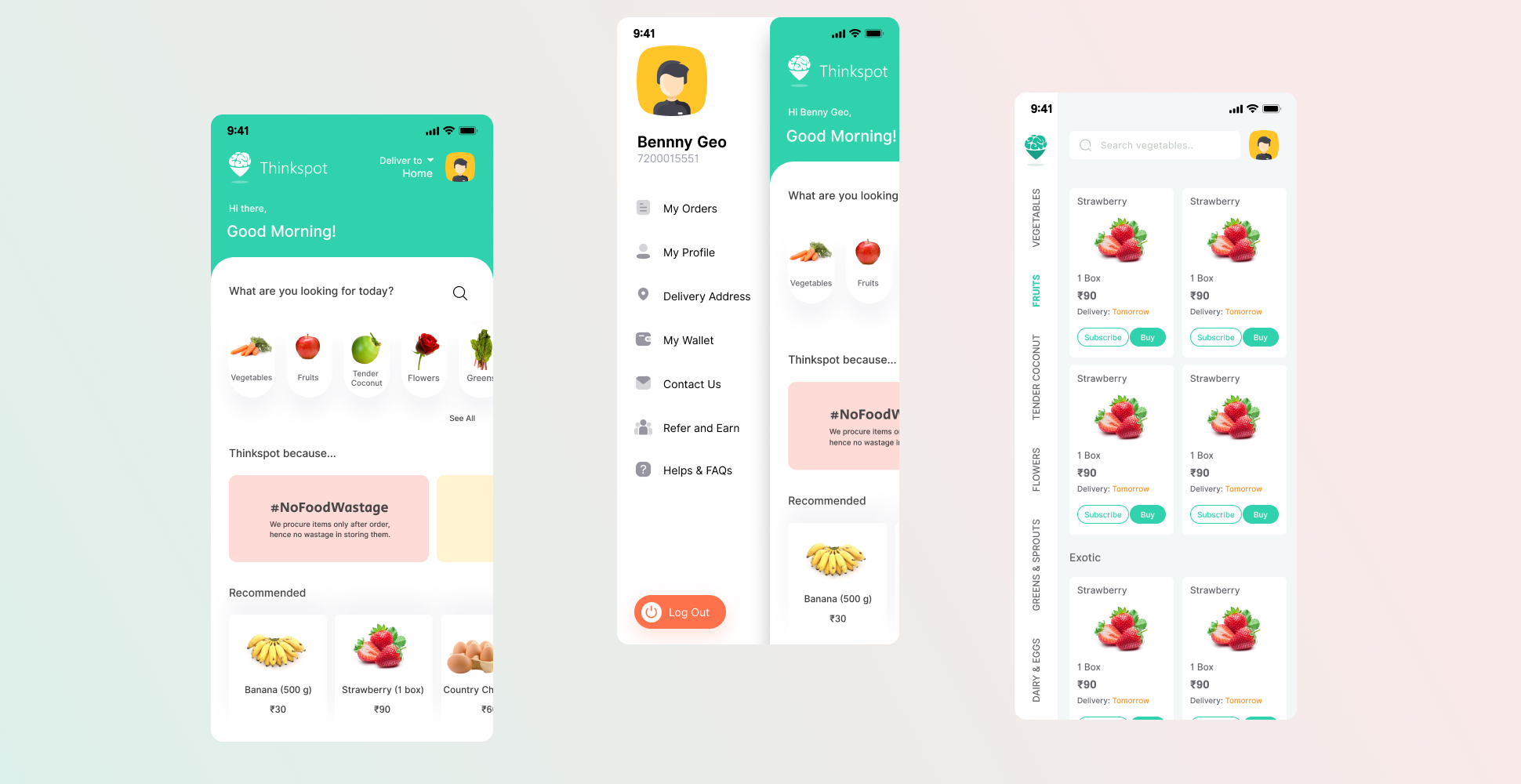
I proposed a mobile-first web experience, packaged within a lightweight Android/iOS wrapper that opened the web experience in a controlled, app-like environment.
This approach allowed:
• A single codebase
• App-store presence and discoverability
• App-like interactions and visual consistency
• Faster iteration and lower cost
• Feature parity across platforms
This decision enabled the product to compete with significantly better-funded players without comparable investment.
System & Experience Design
The experience was designed to:
• Feel native in interaction and visual language
• Support subscription flows, including pausing and resuming subscriptions
• Build trust through clarity, predictability, and transparency
• Optimize performance for mobile usage patterns
Every design decision prioritized usability, trust, and perceived quality over technical purity.
Trade-offs & Risk Management
This approach involved calculated trade-offs:
• Accepting limitations of web-based performance in exchange for speed and reach
• Designing within browser constraints while masking them through UX decisions
• Focusing on core user journeys rather than edge cases
These trade-offs were intentional and aligned with business priorities at that stage.
Outcome & Impact
• The product successfully launched with an app-like experience
• Users were unable to distinguish the solution from a native app without being told
• Subscription and pause-subscription features were implemented effectively
• The business achieved market presence without the cost of native app development
This approach allowed Thinkspot to compete in a space where larger players were spending significantly more on native development.
Why This Work Matters
This project demonstrates my ability to:
• Make strategic product decisions under real constraints
• Balance user experience, technical feasibility, and business goals
• Lead UX beyond screens into platform and architecture decisions
• Deliver competitive experiences without over-engineering
• Think like a product leader, not just a designer
In many organizations, constraints are the default. Strong UX leadership turns those constraints into strategic advantages.